
How Do Modern Bird Repellents Keep Solar Panels Clean and Bird-Free?
Solar panels are meant to sit there and quietly do their job. No real maintenance stress, no surprises, just steady energy in the background. That’s how it’s supposed to be.
Bird repellent for solar panels has become something a lot of people only think about once pigeons have already moved in. The problem is simple. Birds find the gap under panels and treat it like a safe nesting spot, and once that starts, it doesn’t stay small for long.
Over time, it builds into a mess, reduced efficiency, and constant cleaning issues. Most people don’t notice it early because everything still “looks fine” from the ground.
Why do solar panels attract birds so easily?
It is not random at all. Solar panels create a warm, sheltered gap underneath them. From a pigeon’s point of view, that space is perfect because it is dry, hidden, and safe from predators.
Once one bird decides to move in, others tend to follow quickly, and that is how a small issue turns into a proper nesting problem.
This is where a proper bird repellent for solar panels becomes important. The goal is not just to push birds away after they arrive. The real goal is to stop that first moment when they decide the space is suitable in the first place.
Prevention always works better than cleaning up after the fact.
Physical barriers still do most of the work
No matter how advanced bird control gets, physical barriers are still the most reliable solution. If birds cannot access the space, they simply cannot nest there, and that removes the problem completely.
Most systems focus on blocking entry points and removing landing zones, depending on the roof layout and how bad the infestation is.
Here is what is commonly used in real setups:
- Bird spikes for solar panels are installed along edges and frames to stop pigeons from landing and settling
- Bird netting for pigeons creates a full physical barrier so birds cannot access the space under the panels at all
- Bird prevention spikes are placed on ridges, gutters, and roof ledges where birds normally gather
- Stainless steel mesh systems are used because they hold up well against the weather and last longer
- Proper installation is more important than the product itself because even small gaps can cause failure
These solutions are not flashy, but they are what actually keep roofs protected long term.
Solar bird repellers and smarter deterrent systems
Alongside physical barriers, there are also tech-based options. A solar bird repeller works by making the area uncomfortable or unpredictable for birds.
Some systems use sound bursts that activate when movement is detected. Others use flashing lights or vibrations that trigger when birds land. The idea is to interrupt their sense of safety so they move somewhere else.
The key thing to understand is that these systems work best as support tools. Birds are adaptable, and over time, they can get used to patterns if there is nothing else backing the system up.
Bird deterrent products and how they actually work together
Bird control is not one single solution. It is a mix of different Bird Deterrent Products that each handle a specific part of the problem.
When they are combined properly, they create a system that is much harder for birds to bypass.
- Physical exclusion systems stop birds from entering the space at all
- Bird spikes remove comfortable landing areas and discourage perching
- Netting blocks full access under solar panels, where nesting normally happens
- Visual and sound-based deterrents add another layer of discomfort
- Cleaning and removal of existing nests before prevention starts
The strongest results always come from combining multiple methods instead of relying on one approach.
What birds actually live under solar panels
This part often gets ignored until damage starts showing up. Once pigeons settle under panels, they do not just sit there quietly. They build nests, leave droppings, and block airflow underneath the system.
Over time, this can reduce energy output without any obvious warning signs at first.
A proper bird repellent for solar panels setup helps prevent all of that from becoming a long-term issue in the first place.
Why installation matters more than the product
This is where a lot of people go wrong. They focus on the product and assume that is enough, but installation is what actually decides whether it works or fails.
Birds only need small gaps to get through. If the netting is loose or spikes are not placed correctly, they will find their way back in without much effort.
That is why proper assessment of the roof and careful fitting make such a big difference. It is not just about adding protection. It is about sealing every possible entry point properly.
What modern bird control actually solves long-term
When everything is done correctly, the difference is huge. Instead of dealing with recurring bird issues, the roof just stays clean and functional.
- Solar panels stay clean and perform at full efficiency
- Nesting is prevented before it even starts
- Roof damage and wear are reduced over time
- Repeat cleaning costs drop significantly
- Birds stop returning to the same areas
- Hidden wiring and panel structures stay protected
It is less about reacting and more about removing the conditions that attract birds in the first place.
Conclusion
Bird problems under solar panels do not fix themselves. In fact, they usually get worse the longer they are ignored.
Modern bird control works because it stops the process early instead of dealing with the damage later. Spikes, nets, and repellers all play a role, but the real effectiveness comes from using them together properly.
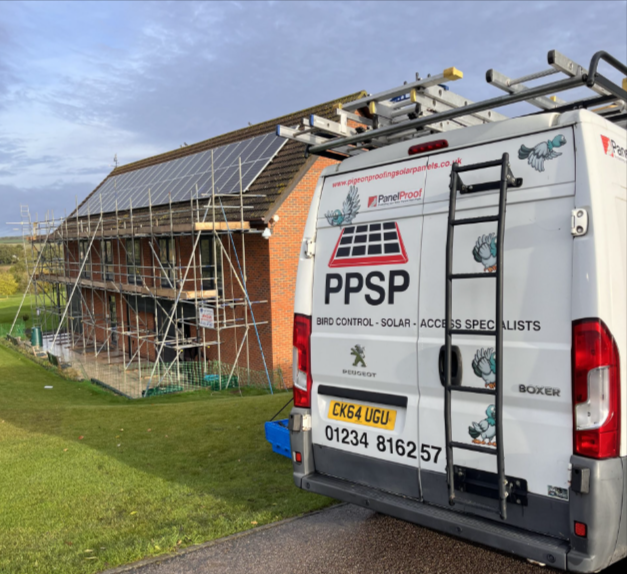
If pigeons are already becoming an issue or you want to avoid the hassle altogether, PPSP Ltd can install a tailored bird repellent for a solar panel system that matches your roof instead of offering a generic fix.
Once the access is gone, everything else becomes simple again.
Book Your Solar Panel Bird Proofing Today
FAQ
What stops birds from nesting under solar panels for good?
Honestly, nothing fancy. You just have to block them out. Bird netting for pigeons does that job because it shuts the gap completely. No access, no nesting. That’s really it. Anything else is just buying time before they come back again.
Do bird spikes for solar panels actually work?
Yeah, they do, but only where birds try to land. Bird spikes for solar panels are fine for edges and frames, places where pigeons sit around. They don’t deal with what’s happening underneath, though, so on their own, they don’t solve the actual nesting issue.
What does a solar bird repeller do?
It’s basically trying to annoy birds into leaving. Sounds, flashing lights, and sometimes movement triggers. It can push them away for a bit. But if pigeons have already decided to nest, it doesn’t really clear them out properly. It’s more of a warning system than a fix.
Why do pigeons keep coming back after removal?
Because the space is still open, that’s the main thing. Under the solar panels stays warm, hidden, an easy shelter for them. If it’s not physically blocked with bird prevention spikes or netting, they just treat it like home and return without much hesitation.
Are bird deterrent products safe for birds?
Yeah, they’re safe. Nothing harmful in them. No chemicals, no traps, nothing like that. They just make the spot uncomfortable or hard to access, so birds don’t stay there. That’s all it is, pushing them out instead of doing anything aggressive.
<- Back to blog